How to Remove Deodorant Marks From Black Shirts

For a fresh white streak, rub the fabric against itself or wipe it with a dry nylon sock or a slightly damp microfiber cloth; the residue usually lifts in seconds. For chalky buildup that has settled into the underarms of dark shirts, soak the area in a 1:1 mix of white vinegar and cool water for 30 minutes, work in liquid detergent, and wash inside out in cold water.
In this guide
What you’ll need
- A clean nylon sock, pair of tights, or foam dryer sheet (unused) for quick fixes
- Microfiber cloth
- White vinegar
- Liquid laundry detergent
- Baking soda (optional, for odor)
- Soft toothbrush
- Small bowl
Quick fix: fresh streaks while you’re dressed
- Pinch the fabric next to the mark and rub that section against the stained section. The fibers of the same fabric act as a gentle eraser.
- If that doesn’t do it, wipe with a nylon sock or tights in short downward strokes. Nylon grabs the powdery particles.
- For stubborn streaks, use a microfiber cloth barely dampened with water. Blot, don’t rub in circles, so you don’t push residue deeper.
- Let the spot air-dry for a minute. A small damp patch dries invisibly on most fabrics.
Deep clean: buildup in the underarms
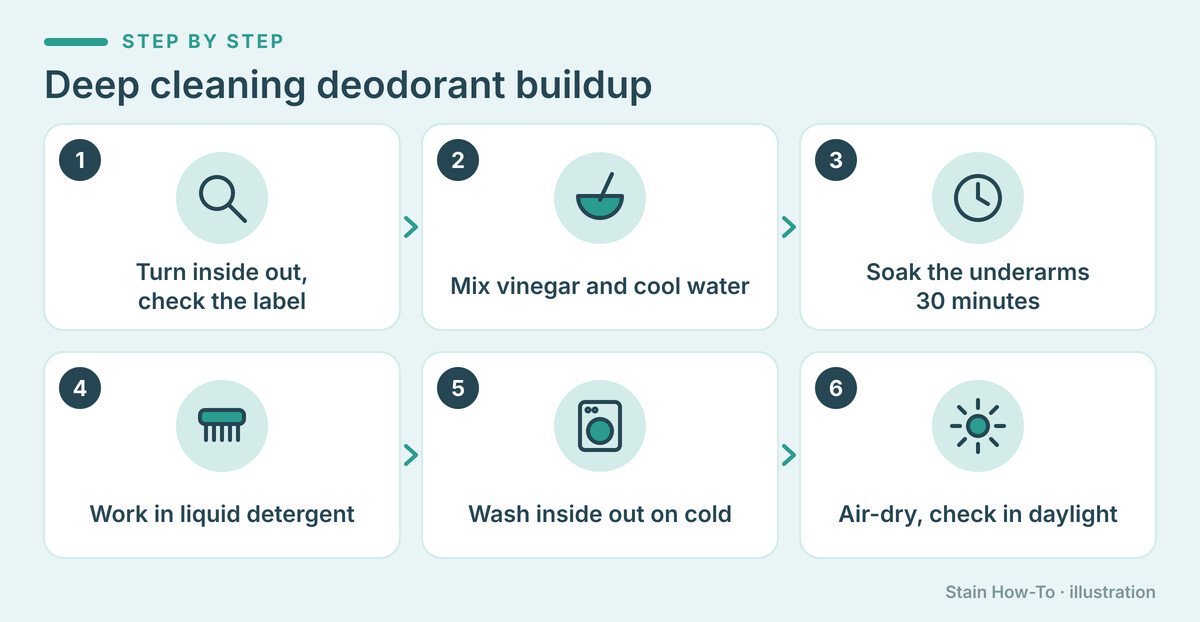
- Turn the shirt inside out and check the care label for maximum temperature.
- Mix 1/2 cup white vinegar with 1/2 cup cool water in a bowl.
- Soak just the underarm areas for 30 minutes. You can dunk them, or lay the shirt flat and saturate the areas with the solution.
- Work in 1 teaspoon of liquid detergent per underarm with a soft toothbrush, using gentle back-and-forth strokes for about 30 seconds.
- Let it sit another 10 minutes.
- Wash inside out on a cold, normal or delicate cycle with your usual detergent. Don’t use extra detergent; excess soap leaves its own residue on dark fabric.
- Air-dry or tumble on low. Check in daylight before wearing; repeat if a gray haze remains.
Why this works
Most white deodorant marks come from antiperspirant. The active ingredients are aluminum salts suspended in waxes, oils, and powders like talc. On dark fabric the powders show immediately as a white streak, and that dry powder sits on the surface, so friction alone removes it. Over many wears, the aluminum compounds combine with sweat and body oils to form a stiff, chalky film bonded to the fibers. Vinegar’s mild acid helps dissolve aluminum salt deposits, while detergent breaks up the waxy and oily carrier. Cold water protects dark dyes from fading during the process.
Mistakes that set the stain
- Hot water. Heat melts waxy deodorant into the weave and fades black dye, leaving a dull patch that looks permanently “stained.”
- Bar soap or too much detergent. Leftover soap leaves a white film on dark fabric that looks just like deodorant.
- Chlorine bleach. It will strip black dye and leave orange or rust-colored blotches. It also reacts with aluminum residue.
- High-heat drying before the residue is gone. The dryer locks wax into the fibers.
- Scrubbing with a stiff brush. This raises fibers and creates a fuzzy, lighter patch.
Preventing marks in the first place
- Let deodorant dry fully before dressing, at least 2 to 3 minutes. Most streaks happen because product is still wet or powdery.
- Apply a thin layer. Extra product doesn’t add protection; it just transfers.
- Use a clear gel or a formula labeled for dark clothing if you wear a lot of black.
- Dress over your head carefully or put deodorant on after your shirt is on and the collar is past your arms.
- Apply at night if you use antiperspirant; it works on clean, dry skin and has time to absorb.
Fabric-specific variations
Cotton t-shirts
Handle the full vinegar soak well. Wash inside out to protect the surface.
Polyester and performance fabrics
These trap oils and odor. Add 1 tablespoon of baking soda to the detergent paste, skip fabric softener (it coats synthetic fibers and traps residue), and air-dry.
Silk and rayon
Don’t soak. Dab with a cloth dampened with a 1:3 vinegar-to-water mix, rinse by blotting with plain water, and air-dry flat. If the mark persists, take it to a dry cleaner.
Knit sweaters
Use the nylon-sock method for fresh streaks. For buildup, hand-wash in cool water with a wool-safe detergent and dry flat.
Black dress shirts
Collar and cuff fabric is often tighter than the body. Treat underarms with the vinegar soak, but test on the inside hem first since some dress-shirt dyes are less stable.
Safety notes
- Never mix vinegar with chlorine bleach; the combination releases chlorine gas. Don’t mix bleach with ammonia either.
- Test vinegar on an inside seam first, especially on rayon, silk, or anything labeled “dry clean.”
- Follow the care label’s temperature and drying limits.
If your white shirts have the opposite problem, yellowing in the underarms, the general soaking approach in how to remove set-in stains after drying applies. For lingering body odor in synthetic fabrics, see how to get rid of musty smell in towels; the same vinegar-and-baking-soda reset works on gym shirts.
FAQ
Why do deodorant marks show up even after washing?
Usually because the residue was never fully dissolved, or because detergent buildup is mimicking it. Use the vinegar soak and cut back on detergent.
Can a dryer sheet remove deodorant marks?
A clean, unused dryer sheet can lift fresh powder by friction, similar to a nylon sock. It won’t help with buildup.
Does baby wipe or makeup wipe work?
Often, for fresh streaks. The mild moisture and soft texture lift powder. Choose unscented, unmedicated wipes and let the spot dry before judging.
Will vinegar make my shirt smell?
Not after rinsing and washing. The smell disappears as the fabric dries.
Related guides
- How to Get Grass Stains Out of Clothes
- How to Get Red Wine Out of Clothes, Carpet, and Couches
- How to Get Grease and Oil Stains Out of Clothes (Even After Drying)
Sources and further reading
Always test a cleaner on a hidden spot first and follow the care label. Never mix bleach with ammonia, vinegar, or other cleaners. Ventilate the room and wear gloves when using strong products.

Darren (Dylan) Dodson writes and maintains Stain How-To. He is based in Raleigh, North Carolina, and started the site because most stain advice online skips the safety basics or suggests mixing products that should never be combined. He holds a B.S. in Geographic Information Science from UNC Greensboro and an M.S. from NC State University, works as a GIS researcher with NC State's Center for Integrated Pest Management, and founded Dodson Development, a web and app development company. He is not a professional cleaner or chemist; methods are checked against care labels, product instructions and published cleaning guidance, and each guide links its sources.


