How to Remove Rust Stains From Clothes

The fastest fix for a rust stain on washable fabric is acid, not detergent. Cover the spot with salt, saturate it with lemon juice, let it sit 30 to 60 minutes (in sunlight if the fabric is white), then rinse and wash. For stubborn or older stains, a laundry rust remover containing oxalic acid usually finishes the job in minutes.
In this guide
What you’ll need
- Fresh or bottled lemon juice (about 2 tablespoons per stain)
- Table salt or kosher salt
- White vinegar as a backup acid
- Cream of tartar (optional, for a paste on whites)
- Oxalic-acid rust remover made for fabric, for stubborn stains
- An old toothbrush or soft brush
- Plastic or glass bowl (not metal)
- Rubber gloves
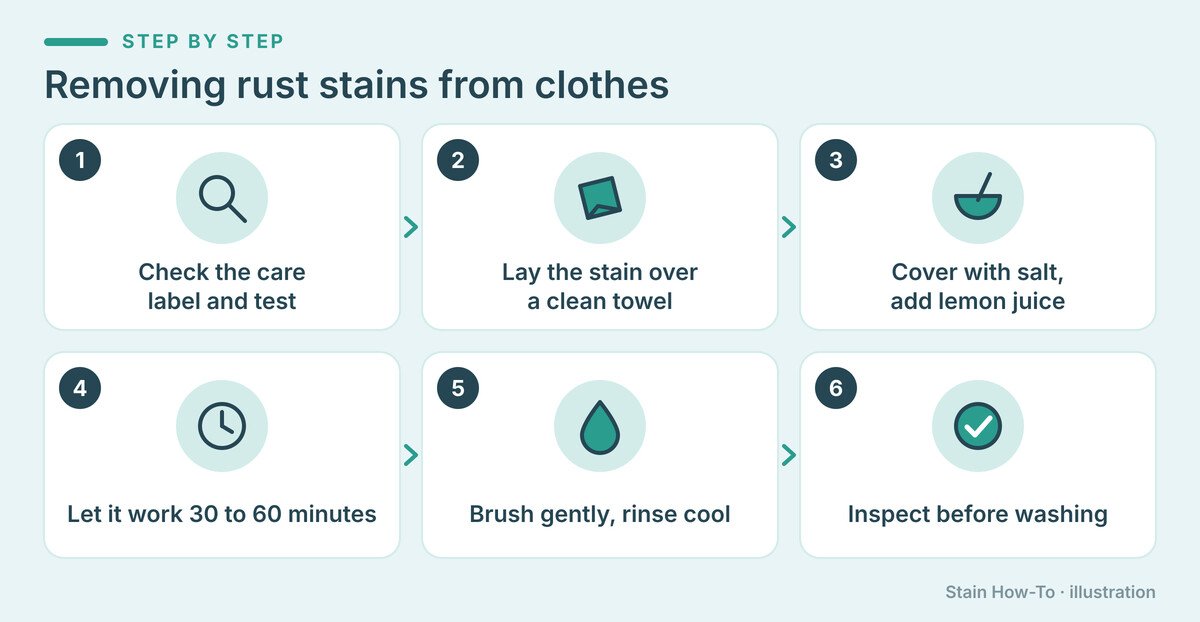
Step-by-step: removing rust from washable fabric
- Check the care label and test. Dab a few drops of lemon juice on an inside seam and wait 10 minutes. If the color lifts onto a white cloth, skip to the colored-fabric variation below.
- Lay the stain flat over a clean towel. This keeps the loosened rust from transferring through to the back of the garment.
- Cover the stain with salt. Use enough to make a visible layer, roughly 1 teaspoon for a coin-sized spot.
- Saturate the salt with lemon juice. Pour slowly until the salt is fully wet but not swimming, about 1 to 2 tablespoons.
- Let it work for 30 to 60 minutes. On white cotton or linen, set the garment in direct sun; light speeds the reaction. Re-wet with lemon juice if the paste dries out.
- Gently brush, then rinse with cool water from the back of the fabric so you push the rust out the way it came in.
- Inspect before washing. If an orange shadow remains, repeat steps 3 to 6 once more.
- For stains that won’t budge, use an oxalic-acid rust remover. Wear gloves, apply according to the label (usually a few drops worked in with the brush), wait the stated time (often 1 to 5 minutes), and rinse thoroughly.
- Wash as usual on the warmest temperature the care label allows, using regular detergent and no chlorine bleach.
- Air-dry and check. Only use a dryer once the stain is completely gone.
Why this works
Rust is iron oxide, a mineral, not an organic soil. Detergents are built to lift oils and proteins, so they barely touch it. Weak acids like citric acid (lemon) and acetic acid (vinegar) dissolve iron oxide and bind the iron into a water-soluble form that rinses out. Oxalic acid does the same thing far more aggressively, which is why it works on stains that lemon can’t move. Salt acts as a mild abrasive and keeps the acid concentrated on the spot. Sunlight adds a gentle bleaching effect on whites that fades the last traces.
Mistakes that set the stain
- Using chlorine bleach. Chlorine oxidizes iron further and can turn a light orange mark into a dark brown one that is close to permanent.
- Drying before the stain is gone. Dryer heat bakes the iron deeper into the fibers.
- Scrubbing hard. Rust particles are abrasive and aggressive scrubbing spreads the stain and roughens fabric.
- Soaking in a metal bucket or bowl. Acid plus metal can create new rust or discoloration.
- Washing it with other whites first. Loose rust can redeposit onto other items in the load.
Fabric-specific variations
White cotton and linen
These are the most forgiving. Use the lemon-and-salt method with sun exposure, or make a paste of cream of tartar and lemon juice and leave it on for up to an hour.
Colored fabrics
Acid can lighten some dyes. Use white vinegar diluted 1 part vinegar to 1 part water instead of straight lemon juice, keep contact time to 15 minutes at a time, and keep the garment out of the sun.
Synthetics (polyester, nylon)
These usually handle lemon juice well because the stain sits more on the surface. Keep wash water at the label’s maximum and avoid high dryer heat even after the stain is out.
Wool, silk, and dry-clean-only items
Don’t use oxalic acid or long acid soaks on protein fibers. Blot a small amount of diluted vinegar on, rinse after 5 minutes, and if that fails, take it to a dry cleaner and point out the rust.
Rust from the washing machine
If you keep finding small rust spots after washing, the source is often a chipped drum, a rusty zipper, or high iron content in your water. Check the drum for exposed metal and remove metal hardware from the load.
Orange blotches that appear after washing clothes worn with sunscreen are a related problem: sunscreen ingredients react with iron and other minerals in the water. They are treated much like rust; see how to get sunscreen stains out of clothes.
Safety notes
- Never mix chlorine bleach with vinegar, lemon juice, or ammonia. Bleach plus acid releases chlorine gas; bleach plus ammonia releases chloramine gas.
- Oxalic acid is toxic if swallowed and irritating to skin. Wear gloves, ventilate the room, and store it away from children.
- Always test any treatment on a hidden area first and follow the care label.
If you’re dealing with rust in more places than your laundry, the same chemistry applies to porcelain: see how to remove rust stains from a bathtub. And if a rust spot already went through the dryer, read our guide to removing set-in stains after drying.
FAQ
Can I use vinegar instead of lemon juice?
Yes. White vinegar is slightly weaker against rust but works on fresh stains. Soak the stain in undiluted vinegar for 30 minutes, then rinse and wash.
Will hydrogen peroxide remove rust?
Not reliably. Peroxide is an oxidizer, and rust is already oxidized iron. It may lighten surrounding discoloration, but it won’t dissolve the iron itself.
How long should I leave lemon juice on?
Thirty to sixty minutes is enough for most fresh stains. Older stains may need two rounds. Don’t leave acid on colored fabric for hours.
What if the stain survived the dryer?
It can usually still come out. Repeat the lemon-and-salt treatment two or three times, then step up to an oxalic-acid product if needed.
Related guides
- How to Remove Set-In Stains After Drying
- How to Remove Deodorant Marks From Black Shirts
- How to Get Grass Stains Out of Clothes
Sources and further reading
Always test a cleaner on a hidden spot first and follow the care label. Never mix bleach with ammonia, vinegar, or other cleaners. Ventilate the room and wear gloves when using strong products.

Darren (Dylan) Dodson writes and maintains Stain How-To. He is based in Raleigh, North Carolina, and started the site because most stain advice online skips the safety basics or suggests mixing products that should never be combined. He holds a B.S. in Geographic Information Science from UNC Greensboro and an M.S. from NC State University, works as a GIS researcher with NC State's Center for Integrated Pest Management, and founded Dodson Development, a web and app development company. He is not a professional cleaner or chemist; methods are checked against care labels, product instructions and published cleaning guidance, and each guide links its sources.


